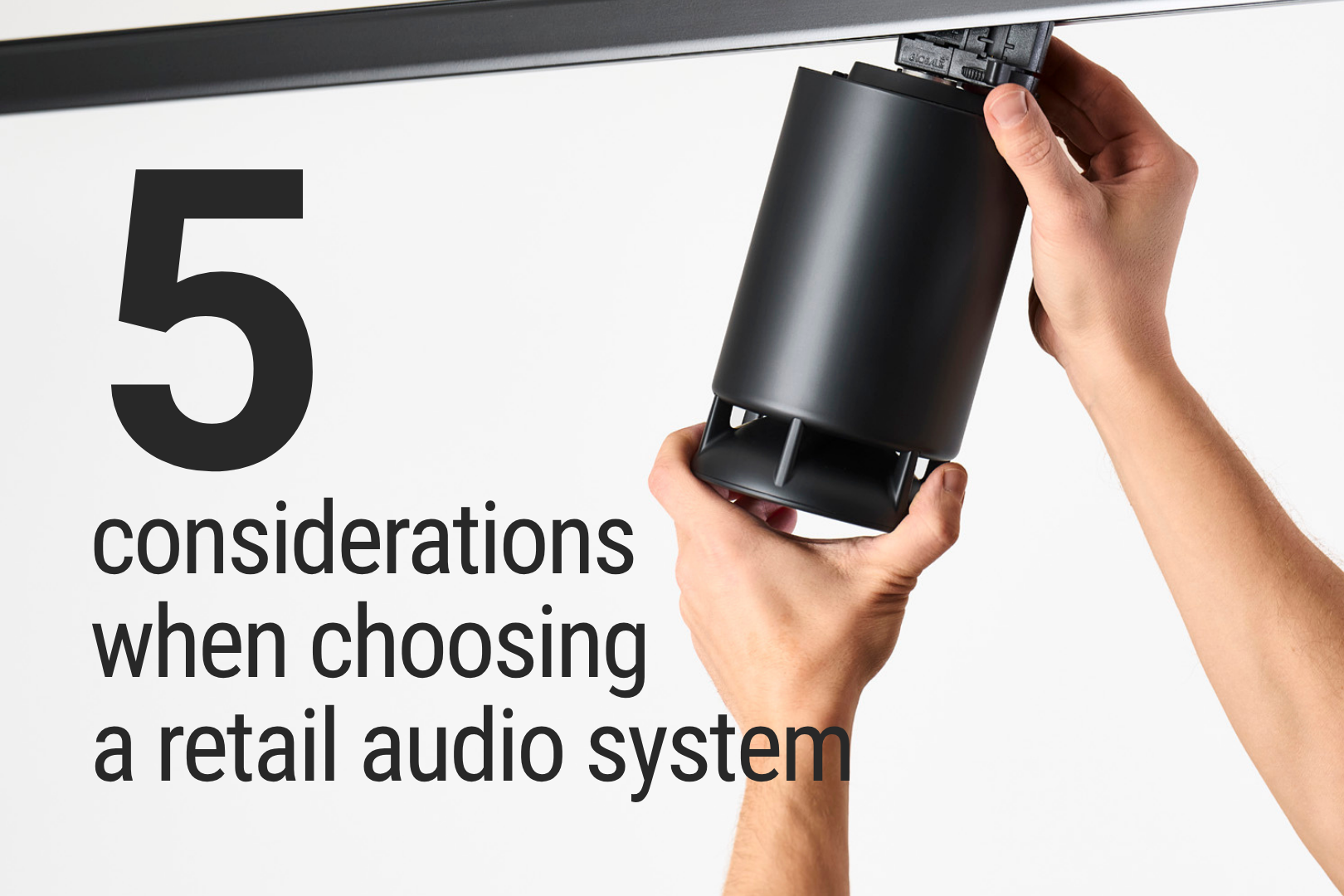
How to Choose a Retail Audio System: 5 Essential Considerations
The audio system in a retail store directly affects how long customers stay, how they feel about your brand, and ultimately whether they buy. Research consistently shows that well-managed in-store music increases dwell time and purchase intent — but only when the system is set up correctly for the space.
This guide covers the five most important factors when selecting a commercial audio system for a retail environment.
Room Size and Acoustics
Before choosing any system, assess the physical characteristics of your store:
- Floor area and ceiling height determine how many speakers are needed and at what power rating
- Hard surfaces (concrete, glass, tile) create echo and require speakers with controlled dispersion
- Soft furnishings (rugs, clothing racks, upholstered fixtures) absorb sound and may require higher output
Standard ceiling speakers typically cover 25–30m² per unit at retail ceiling heights. Spottune's OmniExperience™ technology uses a patented 360° omnidirectional acoustic design that distributes all frequencies evenly in every direction — allowing one speaker to cover up to 75m². In practice, this means up to 50% fewer speakers compared to conventional directional systems, which directly reduces both hardware and installation costs.
Common mistake: Buying a system based on wattage alone, without accounting for room acoustics. A 100W system in a reverberant space sounds worse than a 40W system in a well-treated one.
Scalability and Zone Control
Retail spaces change. Seasonal reconfigurations, expansions, or shop-in-shop concepts all affect how audio should behave across your floor. A good commercial audio system should support:
- Independent volume zones (e.g. louder near the entrance, quieter in fitting rooms)
- Wireless speaker placement that can be repositioned without rewiring
- Expandability — adding speakers or zones without replacing the core system
Wireless audio systems are particularly well-suited for retail because they eliminate the cost and disruption of running cables during installation or reconfiguration.
Sound Quality for Retail Environments
Background music in retail has a specific requirement: it should be present but not intrusive. The system needs to deliver:
- Consistent SPL (sound pressure level) across the whole floor — no loud spots near speakers, no dead zones in corners
- Frequency balance suited to music — adequate bass response and clear mids
- Remote or app-based control so staff can adjust volume or switch playlists without accessing equipment physically
Systems that integrate with music streaming platforms or playlist management services are significantly easier to manage day-to-day.
Speaker Design and Visual Integration
In retail environments, speakers are part of the store design. Key considerations:
- Compact form factor — small satellite speakers or in-ceiling options are less visually disruptive
- Finish options — white, black, or wood-effect housings that complement interior design
- Cable management — wireless systems eliminate visible wiring entirely
The goal is for customers to notice the music, not the equipment.
Installation Cost and Total Cost of Ownership
The price of an audio system goes beyond the hardware. When budgeting, account for:
For most small-to-medium retail stores, a wireless system has a lower total cost over a 3–5 year period, even if the upfront hardware cost is slightly higher, because installation and future changes are far cheaper.
Frequently Asked Questions
What type of audio system is best for a retail store? For most retail environments, a wireless multi-zone speaker system with app-based control offers the best combination of sound quality, flexibility, and ease of installation. Wired systems may be appropriate for large permanent installations where zones will not change.
How many speakers do I need for my shop? A general rule is one speaker per 25–30m² for standard ceiling-mounted speakers. Spottune's omnidirectional speakers cover up to 75m² per unit, meaning up to 50% fewer speakers are needed. Room acoustics, ceiling height, and background noise levels all affect the final count.
Can I use a consumer Bluetooth speaker in a retail store? Technically yes, but it's not recommended. Consumer speakers lack the reliability, sound distribution, and zone control required for a professional retail environment. They are also typically not designed for continuous all-day use.
Summary
Choosing the right audio system for a retail store comes down to five factors: understanding your room's acoustics, planning for scalability, ensuring consistent sound quality, integrating equipment discreetly into the store design, and calculating the true cost including installation and future changes.
Spottune's wireless omnidirectional speakers are built specifically for retail environments — easy to install without cabling, expandable as your store grows, and capable of covering up to 75m² per speaker with consistent 360° sound. Use the speaker calculator to find out how many speakers your space needs.